DAVE3700 konteeksamen 2020 – løsningsforslag
Matte 3000 at OsloMet: every exercise from the exam, with answers and step-by-step solutions. Try it yourself first – the solution is under each exercise.
27. februar 2020
Exercises
5 exercises
Exercise 1
A particle is moving with acceleration
Exercise 1a)
Determine the velocity using the initial condition
Show solutionHide solution for exercise 1a
Answer
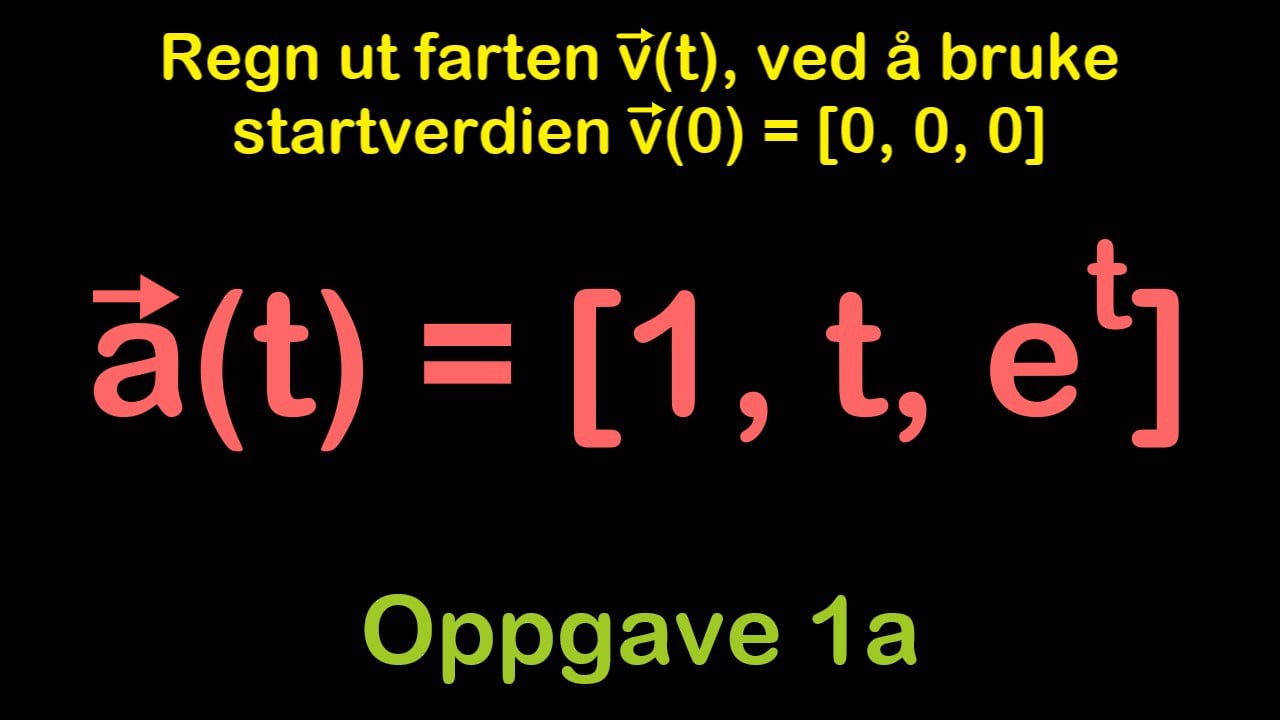 Video på matte.no: Regn ut farten med initialbetingelsene v(0) = [0, 0, 0] - Parametrisering 1a, video, 07:17
The acceleration is the derivative of the velocity. So we find the velocity by integrating the acceleration, and determine the constants with the initial condition.
1. Write down the relation 0:29
The velocity is the derivative of the position, and the acceleration is the derivative of the velocity:
\[ \vec{v}(t) = \vec{r}\,'(t), \qquad \vec{a}(t) = \vec{v}\,'(t) \]If you are unsure about this, you can watch the video Posisjon, fart & akselerasjon.
We go backwards from the acceleration to the velocity by integrating:
\[ \vec{v}(t) = \int \vec{a}(t)\,dt \]
2. Integrate component by component 1:06
The power rule and the rule for \( e^t \) tell us that:
\[ \begin{aligned} \int t^n\,dt &= \dfrac{t^{n+1}}{n+1} + C, \quad n \neq -1 \\ \int e^t\,dt &= e^t + C \end{aligned} \]If you are unsure about the rules, you can watch the video Basic integrasjonsregler/formler.
We integrate each component on its own, with one constant for each:
\[ \begin{aligned} \vec{v}(t) &= \left(\int \textcolor{blue}{1}\,dt,\ \int \textcolor{red}{t}\,dt,\ \int \textcolor{green}{e^t}\,dt\right) \\ &= \left(\textcolor{blue}{t + C_1},\ \textcolor{red}{\tfrac{1}{2}t^2 + C_2},\ \textcolor{green}{e^t + C_3}\right) \end{aligned} \]
3. Determine the constants 3:54
We put in \( {t = 0}\text{.} \) The terms with \( t \) become \( 0\text{,} \) but \( {e^0 = 1}\text{:} \)
\[ \vec{v}(0) = (\textcolor{blue}{C_1},\ \textcolor{red}{C_2},\ \textcolor{green}{1 + C_3}) \]
The initial condition says that this is \( (0, 0, 0)\text{.} \) We set the components equal one by one:
\[ \textcolor{blue}{C_1} = 0, \quad \textcolor{red}{C_2} = 0, \quad \textcolor{green}{1 + C_3} = 0 \]
That gives \( {C_3 = -1}\text{.} \) Plugging the constants in, we get:
\[ \vec{v}(t) = \left(t,\ \tfrac{1}{2}t^2,\ e^t - 1\right) \]
Exercise 1b)
Compute the position using the initial condition
Show solutionHide solution for exercise 1b
Answer
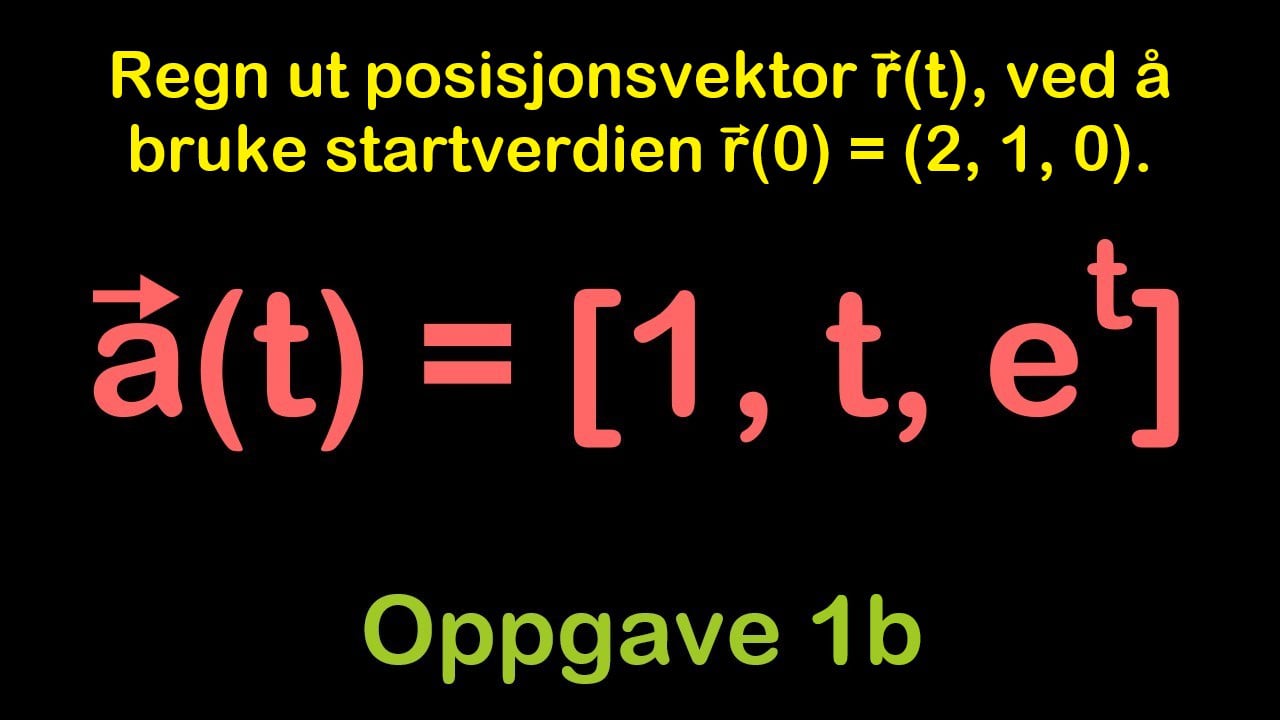 Video på matte.no: Regn ut posisjonen med initialbetingelsene r(0) = [2, 1, 0] - 1b, video, 06:55
We use the velocity from a).
The velocity is the derivative of the position. So we integrate the velocity from a) component by component, and determine the constants with the initial condition.
1. Integrate the velocity 0:32
In a) we found the velocity:
\[ \vec{v}(t) = \left(t,\ \tfrac{1}{2}t^2,\ e^t - 1\right) \]
Since \( {\vec{r}\,'(t) = \vec{v}(t)}\text{,} \) the position is the integral of the velocity, as in the video Posisjon, fart & akselerasjon:
\[ \vec{r}(t) = \int \vec{v}(t)\,dt \]
The power rule and the rule for \( e^t \) tell us that:
\[ \begin{aligned} \int t^n\,dt &= \dfrac{t^{n+1}}{n+1} + C, \quad n \neq -1 \\ \int e^t\,dt &= e^t + C \end{aligned} \]If you are unsure about the rules, you can watch the video Basic integrasjonsregler/formler.
We integrate each component on its own, with one constant for each:
\[ \begin{aligned} \int \textcolor{blue}{t}\,dt &= \textcolor{blue}{\tfrac{1}{2}t^2 + C_1} \\ \int \textcolor{red}{\tfrac{1}{2}t^2}\,dt &= \textcolor{red}{\tfrac{1}{6}t^3 + C_2} \\ \int \textcolor{green}{(e^t - 1)}\,dt &= \textcolor{green}{e^t - t + C_3} \end{aligned} \]
That gives us:
\[ \begin{aligned} \vec{r}(t) = \big(&\textcolor{blue}{\tfrac{1}{2}t^2 + C_1},\ \textcolor{red}{\tfrac{1}{6}t^3 + C_2}, \\ &\textcolor{green}{e^t - t + C_3}\big) \end{aligned} \]
2. Determine the constants 4:03
We put in \( {t = 0}\text{.} \) The terms with \( t \) become \( 0\text{,} \) but \( {e^0 = 1}\text{:} \)
\[ \vec{r}(0) = (\textcolor{blue}{C_1},\ \textcolor{red}{C_2},\ \textcolor{green}{1 + C_3}) \]
The initial condition says that this is \( (2, 1, 0)\text{.} \) We set the components equal one by one:
\[ \textcolor{blue}{C_1} = 2, \quad \textcolor{red}{C_2} = 1, \quad \textcolor{green}{1 + C_3} = 0 \]
That gives \( {C_3 = -1}\text{.} \) Plugging the constants in, we get:
\[ \begin{aligned} \vec{r}(t) = \big(&\tfrac{1}{2}t^2 + 2,\ \tfrac{1}{6}t^3 + 1, \\ &e^t - t - 1\big) \end{aligned} \]
Exercise 2
Exercise 2a)
Determine the region in the plane bounded by the curves
Give a sketch of the region.
Show solutionHide solution for exercise 2a
Answer
lies between the line and the parabola which intersect at and
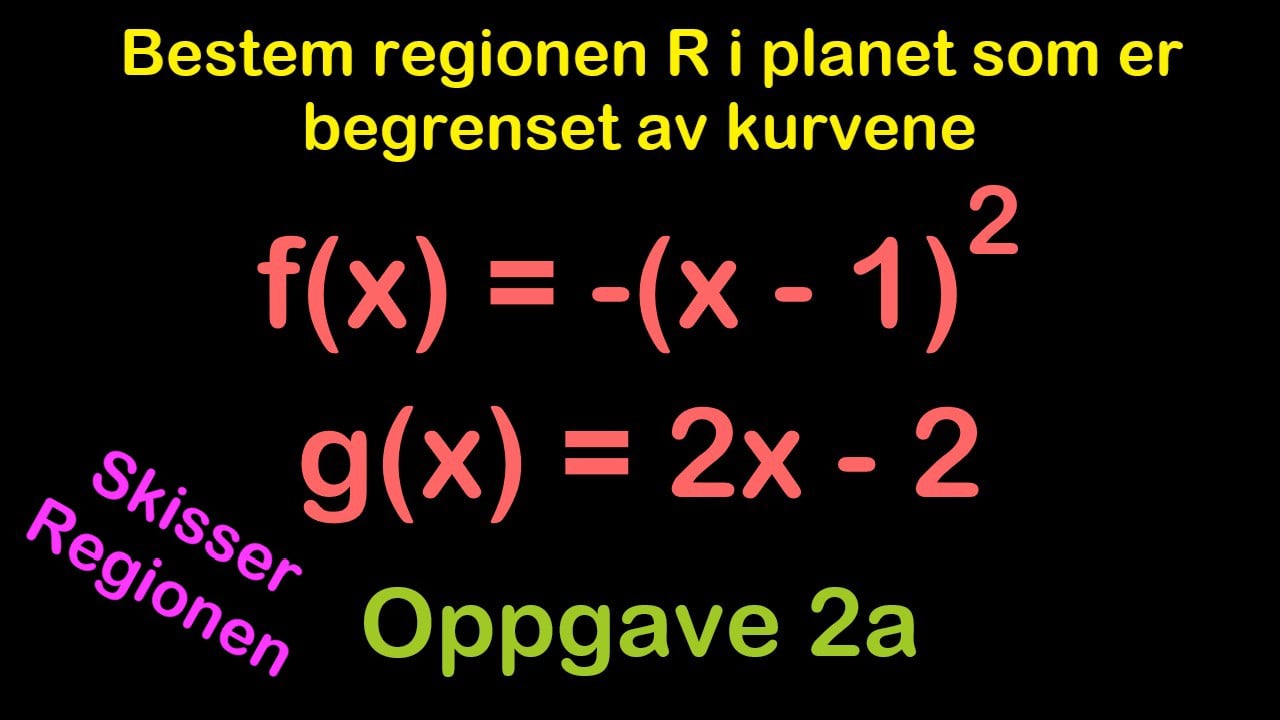 Video på matte.no: Bestem regionen R i planet som er begrenset av kurvene - 2a, video, 11:01
What determines the region is where the curves intersect. So we set \( {f(x) = g(x)}\text{,} \) and then find which curve lies on top.
1. Set the curves equal 0:42
The curves intersect where:
\[ -(x - 1)^2 = 2x - 2 \]
The formula for the square of a difference tells us that:
\[ (\textcolor{blue}{a} - \textcolor{red}{b})^2 = \textcolor{blue}{a}^2 - 2\textcolor{blue}{a}\textcolor{red}{b} + \textcolor{red}{b}^2 \]If you are unsure about it, you can watch the video Kvadratsetningene.
Here \( {\textcolor{blue}{a} = \textcolor{blue}{x}} \) and \( {\textcolor{red}{b} = \textcolor{red}{1}}\text{,} \) so:
\[ (\textcolor{blue}{x} - \textcolor{red}{1})^2 = \textcolor{blue}{x}^2 - 2\textcolor{blue}{x} + \textcolor{red}{1} \]
We distribute the minus sign and solve the equation:
\[ \begin{aligned} -x^2 + 2x - 1 &= 2x - 2 \\ -x^2 + 1 &= 0 \\ x^2 &= 1 \\ x &= \pm 1 \end{aligned} \]
2. Find the intersection points
We put \( {x = -1} \) and \( {x = 1} \) into \( g\text{:} \)
\[ \begin{aligned} g(-1) &= 2 \cdot (-1) - 2 = -4 \\ g(1) &= 2 \cdot 1 - 2 = 0 \end{aligned} \]
So the curves intersect at \( {(-1, -4)} \) and \( (1, 0)\text{.} \)
3. Find the curve on top
From the equation above:
\[ f(x) - g(x) = -x^2 + 1 = 1 - x^2 \]
For \( {-1 \le x \le 1} \) we have \( {x^2 \le 1}\text{,} \) so \( {f(x) - g(x) \ge 0}\text{.} \) The parabola \( f \) therefore lies above the line \( g\text{,} \) and the region \( R \) is given by:
\[ \begin{aligned} -1 &\le x \le 1 \\ 2x - 2 &\le y \le -(x - 1)^2 \end{aligned} \]
4. Sketch the region 4:26
\( f \) is a parabola opening downwards, with its vertex at \( (1, 0)\text{,} \) and \( g \) is a straight line. \( R \) is the region between them:
Exercise 2b)
Compute the area of using a double integral.
Show solutionHide solution for exercise 2b
Answer
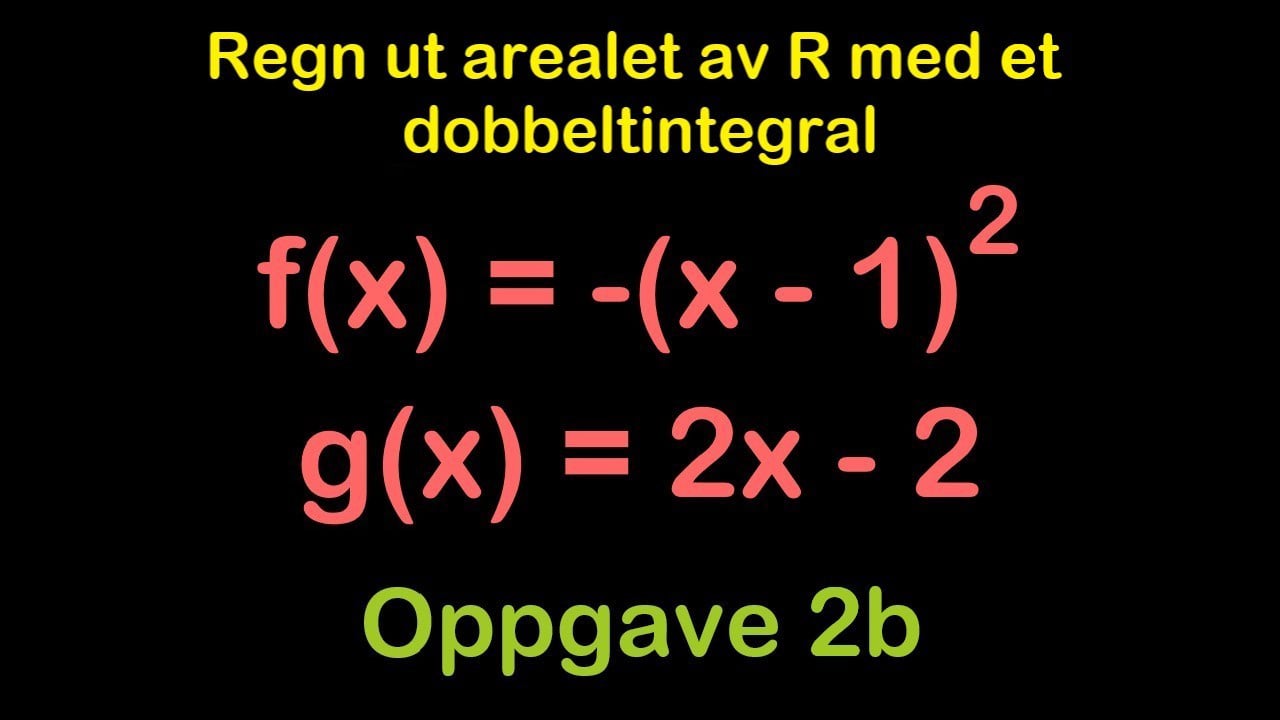 Video på matte.no: Regn ut arealet av R med en dobbeltintegral - Multiple integraler 2b, video, 07:28
We use the bounds for \( R \) from a).
The area is the double integral of \( 1 \) over \( R\text{.} \) We integrate with respect to \( y \) first, from the line up to the parabola.
1. Set up the double integral 1:16
The area of a region between two graphs is:
\[ A = \iint_R 1\,dA = \int_a^b\!\!\int_{\textcolor{red}{g(x)}}^{\textcolor{blue}{f(x)}} 1\,dy\,dx \]If you are unsure about this, you can watch the video Ekstra kunnskap.
In a) we found the region \( R\text{.} \) With \( \textcolor{blue}{f(x)} \) multiplied out as in a), it is:
\[ \begin{aligned} -1 &\le x \le 1 \\ \textcolor{red}{2x - 2} &\le y \le \textcolor{blue}{-x^2 + 2x - 1} \end{aligned} \]
Plugging this in, we get:
\[ A = \int_{-1}^{1}\!\!\int_{\textcolor{red}{2x - 2}}^{\textcolor{blue}{-x^2 + 2x - 1}} 1\,dy\,dx \]
2. Compute the inner integral 3:10
We integrate with respect to \( y \) and put in the bounds, upper minus lower:
\[ \begin{aligned} &\int_{\textcolor{red}{2x - 2}}^{\textcolor{blue}{-x^2 + 2x - 1}} 1\,dy \\ &= \Big[y\Big]_{\textcolor{red}{2x - 2}}^{\textcolor{blue}{-x^2 + 2x - 1}} \\ &= \textcolor{blue}{-x^2 + 2x - 1} - (\textcolor{red}{2x - 2}) \\ &= -x^2 + 1 \end{aligned} \]
3. Compute the outer integral 5:08
The power rule tells us that:
\[ \int x^n\,dx = \dfrac{x^{n+1}}{n+1} + C, \quad n \neq -1 \]If you are unsure about the rule, you can watch the video Basic integrasjonsregler/formler.
We integrate term by term:
\[ \begin{aligned} A &= \int_{-1}^{1} (-x^2 + 1)\,dx \\ &= \left[-\dfrac{x^3}{3} + x\right]_{-1}^{1} \\ &= \left(-\dfrac{1}{3} + 1\right) - \left(\dfrac{1}{3} - 1\right) \\ &= \dfrac{4}{3} \end{aligned} \]
Exercise 3
- Flere oppgaver om curl og divergens,
- Flere oppgaver om greens teorem,
- Flere oppgaver om konservative vektorfelt,
- Flere oppgaver om linjeintegraler,
- Flere oppgaver om polarkoordinater
Consider the vector field in the plane
Exercise 3a)
Let be the circle of radius centered at the origin. Compute the line integral (the work done by ) using Green's theorem.
Show solutionHide solution for exercise 3a
Answer
Around counterclockwise, the line integral is:
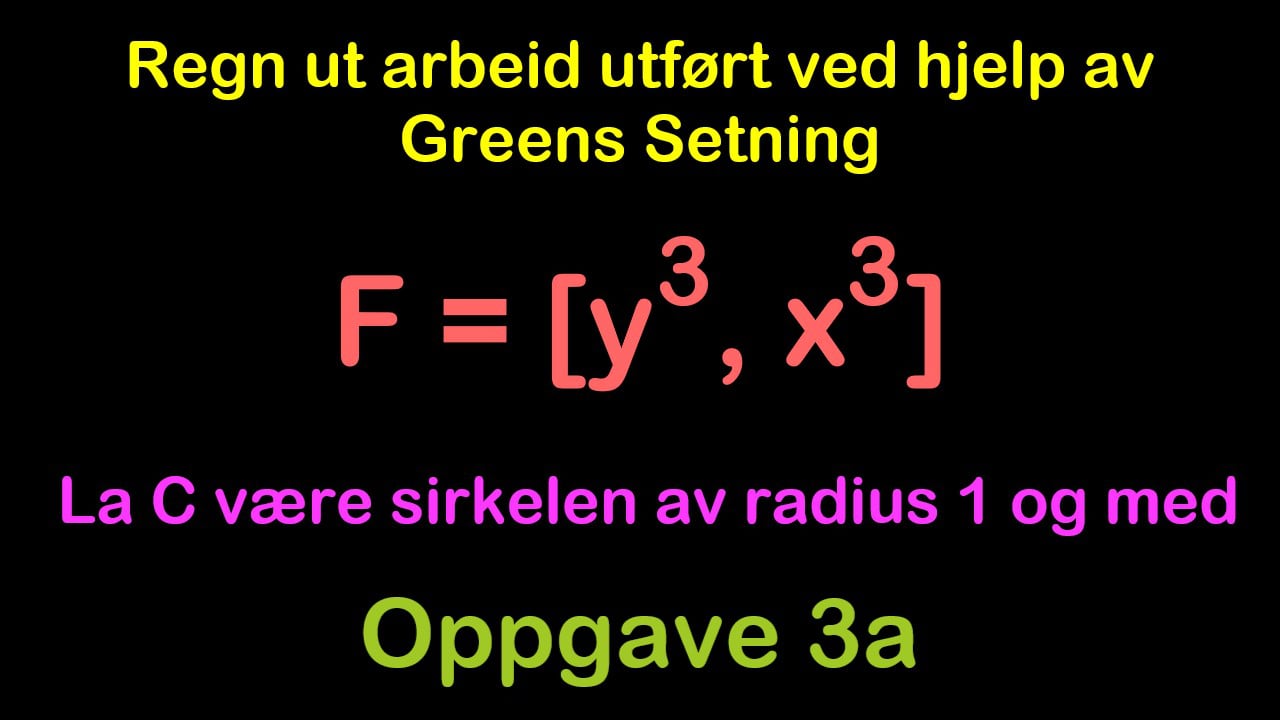 Video på matte.no: Regn ut arbeidet utført av F ved hjelp av Greens Setning - 3a, video, 10:04
\( C \) is a closed curve, so Green's theorem turns the line integral into a double integral over the disk. There we change to polar coordinates.
1. Draw a sketch
We draw a sketch first. We go around \( C \) counterclockwise, as Green's theorem assumes, and \( D \) is the disk inside:
2. Write down Green's theorem 1:27
When \( {\vec{F} = (\textcolor{blue}{P},\ \textcolor{red}{Q})} \) and \( C \) goes counterclockwise around \( D\text{,} \) Green's theorem tells us that:
\[ \oint_C \vec{F} \cdot d\vec{r} = \iint_D \left(\dfrac{\partial \textcolor{red}{Q}}{\partial x} - \dfrac{\partial \textcolor{blue}{P}}{\partial y}\right) dA \]If you are unsure about Green's theorem, you can watch the video Greens setning.
Here:
\[ \begin{aligned} \textcolor{blue}{P} &= \textcolor{blue}{-y^3} & \dfrac{\partial \textcolor{blue}{P}}{\partial y} &= \textcolor{blue}{-3y^2} \\ \textcolor{red}{Q} &= \textcolor{red}{x^3} & \dfrac{\partial \textcolor{red}{Q}}{\partial x} &= \textcolor{red}{3x^2} \end{aligned} \]
Plugging this in, we get:
\[ \begin{aligned} \oint_C \vec{F} \cdot d\vec{r} &= \iint_D \big(\textcolor{red}{3x^2} - (\textcolor{blue}{-3y^2})\big)\,dA \\ &= 3\iint_D (x^2 + y^2)\,dA \end{aligned} \]
3. Change to polar coordinates 4:41
\( D \) is a disk, and the integrand is \( {x^2 + y^2}\text{.} \) In polar coordinates:
\[ x^2 + y^2 = \textcolor{green}{r^2}, \qquad dA = \textcolor{darkorange}{r}\,dr\,d\theta \]If you are unsure about the change, you can watch the video Dobbelt integral.
The radius goes from \( 0 \) to \( 1\text{,} \) and the angle from \( 0 \) to \( 2\pi\text{,} \) a full turn. Plugging this in, we get:
\[ \begin{aligned} \oint_C \vec{F} \cdot d\vec{r} &= 3\int_0^{2\pi}\!\!\int_0^1 \textcolor{green}{r^2} \cdot \textcolor{darkorange}{r}\,dr\,d\theta \\ &= 3\int_0^{2\pi}\!\!\int_0^1 r^3\,dr\,d\theta \end{aligned} \]
4. Compute the integral 7:26
The power rule tells us that:
\[ \int r^n\,dr = \dfrac{r^{n+1}}{n+1} + C, \quad n \neq -1 \]If you are unsure about the rule, you can watch the video Basic integrasjonsregler/formler.
Here \( {n = 3}\text{,} \) so the inner integral is:
\[ \int_0^1 r^3\,dr = \left[\dfrac{r^4}{4}\right]_0^1 = \dfrac{1}{4} \]
In the outer integral the integrand is a constant, so we multiply by \( 2\pi\text{:} \)
\[ \oint_C \vec{F} \cdot d\vec{r} = 3 \cdot \dfrac{1}{4} \cdot 2\pi = \dfrac{3\pi}{2} \]
Exercise 3b)
Can you conclude from a) if the vector field is conservative or not? Check your answer by computing the curl of
Show solutionHide solution for exercise 3b
Answer
Yes, the integral in a) shows that is not conservative, and the curl confirms it:
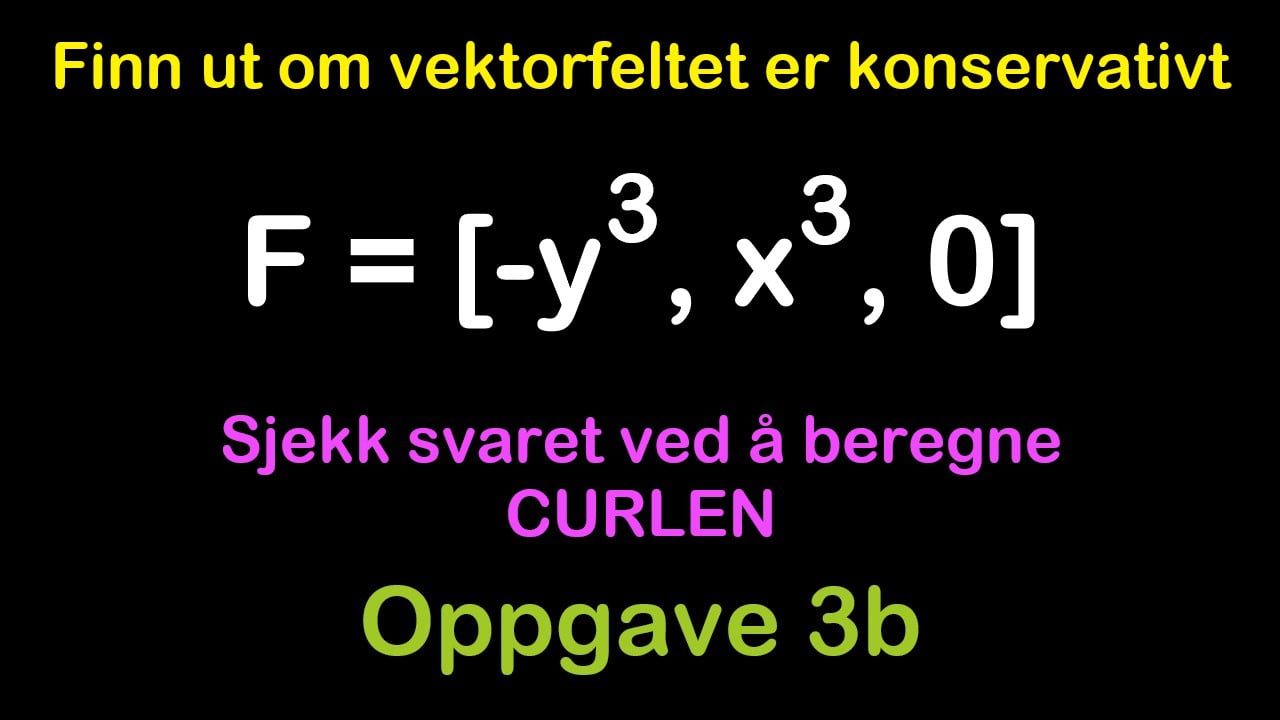 Video på matte.no: Finn ut om vektorfeltet er konservativt - Konservativt vektorfelt - 3b, video, 05:49
We use the line integral from a).
A conservative field gives \( 0 \) around every closed curve. We compare with a), and check with the curl.
1. Use the answer from a) 0:09
For a conservative field, the line integral around every closed curve is \( 0\text{:} \)
\[ \vec{F} \text{ conservative} \;\Rightarrow\; \oint_C \vec{F} \cdot d\vec{r} = 0 \]If you are unsure about this, you can watch the video Hva er et konservativt vektorfelt.
The circle \( C \) in a) is a closed curve, and there we found:
\[ \oint_C \vec{F} \cdot d\vec{r} = \dfrac{3\pi}{2} \neq 0 \]
It is enough that the integral around one closed curve is not \( 0\text{.} \) Yes, we can conclude: \( \vec{F} \) is not conservative.
2. Compute the curl 1:11
The curl is:
\[ \nabla \times \vec{F} = \begin{vmatrix} \hat{i} & \hat{j} & \hat{k} \\ \dfrac{\partial}{\partial x} & \dfrac{\partial}{\partial y} & \dfrac{\partial}{\partial z} \\ \textcolor{blue}{F_1} & \textcolor{red}{F_2} & \textcolor{green}{F_3} \end{vmatrix} \]If you are unsure about the curl, you can watch the video Finn et generelt uttrykk for curlen til vektorfeltet.
Expanding the determinant along the first row, we get:
\[ \nabla \times \vec{F} = \begin{pmatrix} \dfrac{\partial \textcolor{green}{F_3}}{\partial y} - \dfrac{\partial \textcolor{red}{F_2}}{\partial z} \\ \dfrac{\partial \textcolor{blue}{F_1}}{\partial z} - \dfrac{\partial \textcolor{green}{F_3}}{\partial x} \\ \dfrac{\partial \textcolor{red}{F_2}}{\partial x} - \dfrac{\partial \textcolor{blue}{F_1}}{\partial y} \end{pmatrix} \]
Here:
\[ \textcolor{blue}{F_1} = \textcolor{blue}{-y^3}, \qquad \textcolor{red}{F_2} = \textcolor{red}{x^3}, \qquad \textcolor{green}{F_3} = \textcolor{green}{0} \]
None of the components depends on \( z\text{,} \) and \( {\textcolor{green}{F_3} = \textcolor{green}{0}}\text{.} \) Then the first two components are \( 0\text{,} \) and we get:
\[ \begin{aligned} \nabla \times \vec{F} &= \big(0,\ 0,\ \textcolor{red}{3x^2} - (\textcolor{blue}{-3y^2})\big) \\ &= (0,\ 0,\ 3x^2 + 3y^2) \end{aligned} \]
3. Conclude 5:09
A conservative field has a curl equal to the zero vector:
\[ \vec{F} \text{ conservative} \;\Rightarrow\; \nabla \times \vec{F} = \vec{0} \]This is criterion 3 in the video Hva er et konservativt vektorfelt.
Here \( {3x^2 + 3y^2 > 0} \) at every point except the origin, so:
\[ \nabla \times \vec{F} \neq \vec{0} \]This confirms the answer from a): \( \vec{F} \) is not conservative.
Exercise 4
Consider the ellipse defined by the equation
Exercise 4a)
Define new coordinates by the formulae
Show that in these coordinates the ellipse becomes a circle of radius
Show solutionHide solution for exercise 4a
Answer
In the the ellipse is the circle with center at the origin and radius
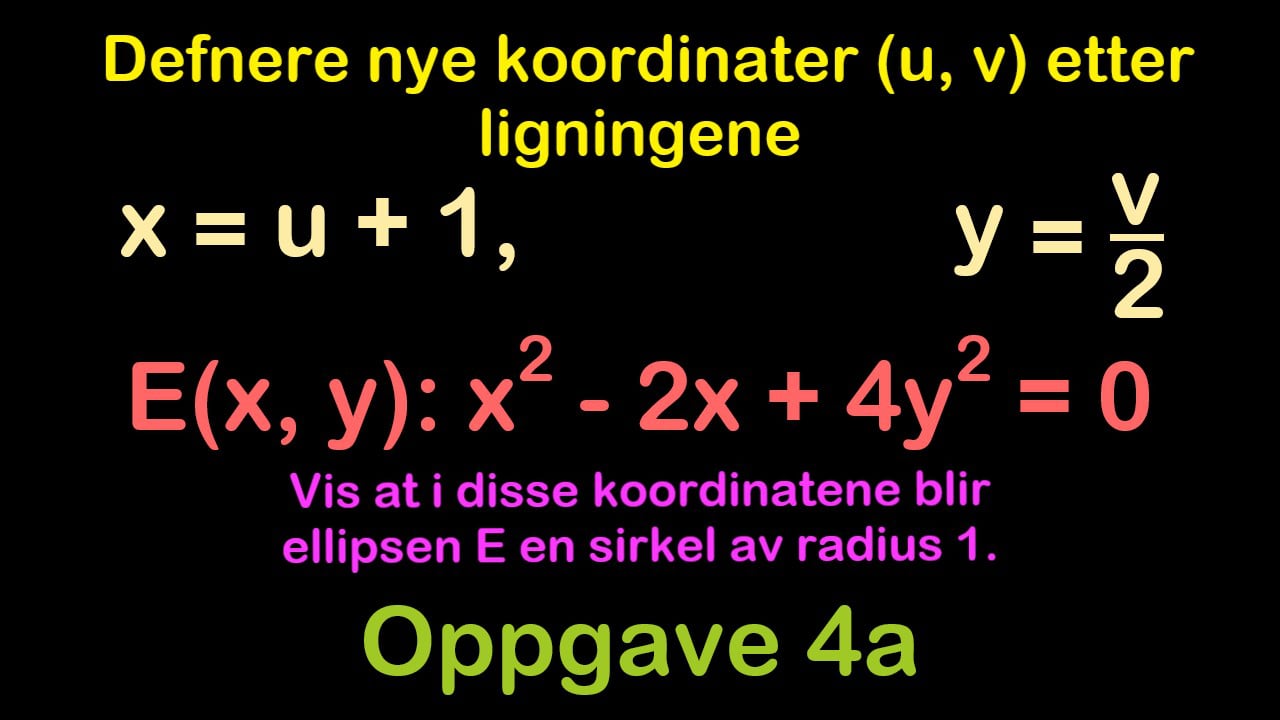 Video på matte.no: Variabelskifte med en 3D funksjon - 4a, video, 07:44
We put \( {x = u + 1} \) and \( {y = \dfrac{v}{2}} \) into the equation of the ellipse and simplify. We should end up with the equation of a circle with radius \( 1\text{.} \)
1. Draw a sketch 0:00
We draw a sketch first. On the left is the ellipse \( E \) in the \( {xy\text{-plane}}\text{,} \) and on the right the circle we are heading for in the \( {uv\text{-plane}}\text{:} \)
A circle with center at the origin and radius \( 1 \) has the equation:
\[ u^2 + v^2 = 1^2 = 1 \]
2. Put in the new coordinates 3:14
We replace \( x \) by \( {u + 1} \) and \( y \) by \( \dfrac{v}{2}\text{:} \)
\[ (u + 1)^2 - 2(u + 1) + 4\left(\dfrac{v}{2}\right)^2 = 0 \]
We compute the terms one by one. The formula for the square of a sum tells us that:
\[ (\textcolor{blue}{a} + \textcolor{red}{b})^2 = \textcolor{blue}{a}^2 + 2\textcolor{blue}{a}\textcolor{red}{b} + \textcolor{red}{b}^2 \]If you are unsure about it, you can watch the video Kvadratsetningene.
\( {(u + 1)^2} \) with \( {\textcolor{blue}{a} = \textcolor{blue}{u}} \) and \( {\textcolor{red}{b} = \textcolor{red}{1}}\text{:} \)
\[ (\textcolor{blue}{u} + \textcolor{red}{1})^2 = \underline{\textcolor{blue}{u}^2 + 2\textcolor{blue}{u} + \textcolor{red}{1}} \]
Multiplying out \( {-2(u + 1)} \) gives:
\[ -2(u + 1) = \underline{-2u - 2} \]
\( {4\left(\dfrac{v}{2}\right)^2}\text{:} \)
\[ 4\left(\dfrac{v}{2}\right)^2 = 4 \cdot \dfrac{v^2}{4} = \underline{v^2} \]
3. Simplify the equation 5:46
Putting this together, we get:
\[ \begin{aligned} u^2 + 2u + 1 - 2u - 2 + v^2 &= 0 \\ u^2 + v^2 - 1 &= 0 \\ u^2 + v^2 &= 1 \end{aligned} \]
This is the equation of the circle with center at the origin and radius \( 1\text{.} \)
Exercise 4b)
Compute the area of using the -coordinates (hint: don't forget the Jacobian).
Show solutionHide solution for exercise 4b
Answer
The area of is:
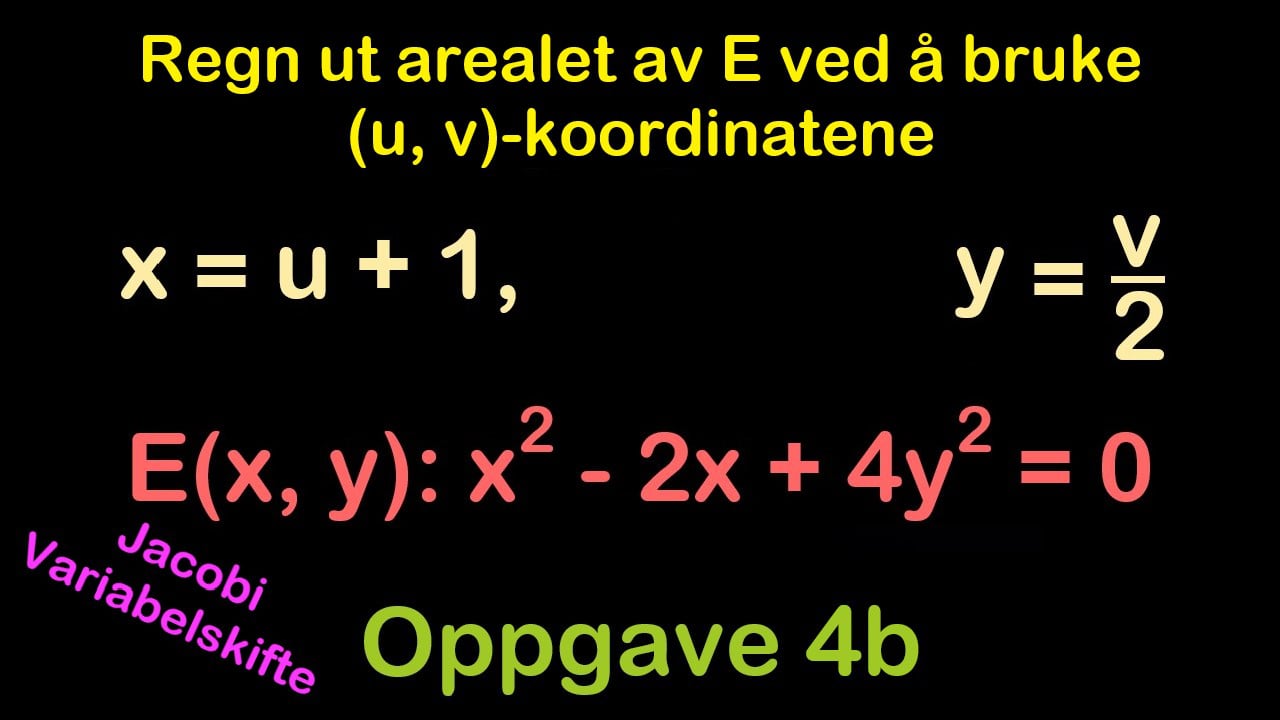 Video på matte.no: Regn ut arealet ved hjelp av variabelskiftet - 4b, video, 12:15
We use the circle from a).
In the \( {(u, v)\text{-coordinates}} \) the ellipse \( E \) is the disk with radius \( 1\text{.} \) The area is the integral of \( |J| \) over the disk, and here the Jacobian \( J \) is a constant.
1. Write down the Jacobian 0:34
The Jacobian for \( {x = x(u, v)} \) and \( {y = y(u, v)} \) is:
\[ J = \begin{vmatrix} \textcolor{blue}{\dfrac{\partial x}{\partial u}} & \textcolor{red}{\dfrac{\partial y}{\partial u}} \\ \textcolor{red}{\dfrac{\partial x}{\partial v}} & \textcolor{blue}{\dfrac{\partial y}{\partial v}} \end{vmatrix} \]If you are unsure about it, you can watch the video Hvor kommer r fra?.
We compute a \( 2 \times 2\text{ determinant} \) like this, as in the video Hvor kommer r fra?:
\[ \begin{vmatrix} \textcolor{blue}{a} & \textcolor{red}{b} \\ \textcolor{red}{c} & \textcolor{blue}{d} \end{vmatrix} = \textcolor{blue}{ad} - \textcolor{red}{bc} \]
2. Compute the Jacobian 1:05
Here are the partial derivatives of \( {x = u + 1} \) and \( {y = \dfrac{v}{2}}\text{:} \)
\[ \begin{aligned} \textcolor{blue}{a} &= \dfrac{\partial x}{\partial u} = \textcolor{blue}{1} & \textcolor{red}{b} &= \dfrac{\partial y}{\partial u} = \textcolor{red}{0} \\ \textcolor{red}{c} &= \dfrac{\partial x}{\partial v} = \textcolor{red}{0} & \textcolor{blue}{d} &= \dfrac{\partial y}{\partial v} = \textcolor{blue}{\dfrac{1}{2}} \end{aligned} \]
Plugging this in, we get:
\[ J = \textcolor{blue}{1 \cdot \dfrac{1}{2}} - \textcolor{red}{0 \cdot 0} = \dfrac{1}{2} \]
3. Write down the area 2:49
The change of variables tells us that the area is:
\[ A = \iint_E dx\,dy = \iint_D |J|\,du\,dv \]where \( D \) is \( E \) in the \( {(u, v)\text{-coordinates}}\text{.} \) In a) we found that it is the disk \( {u^2 + v^2 \le 1}\text{.} \)
\( {J = \dfrac{1}{2}} \) is positive, so \( {|J| = J}\text{.} \) It is a constant, so we move it outside:
\[ A = \iint_D \left|\dfrac{1}{2}\right| du\,dv = \dfrac{1}{2}\iint_D du\,dv \]
4. Compute the area 4:47
The integral \( \iint_D du\,dv \) is the area of the disk with radius \( 1\text{.} \) The area of a circle is \( \pi r^2\text{,} \) as in the video Dobbelt integral:
\[ \iint_D du\,dv = \pi \cdot 1^2 = \pi \]
That gives us:
\[ A = \dfrac{1}{2} \cdot \pi = \dfrac{\pi}{2} \]
Exercise 5
- Flere oppgaver om dobbeltintegraler,
- Flere oppgaver om flateintegraler,
- Flere oppgaver om partielle deriverte
Let be the graph of
with and
Exercise 5a)
Compute the area of as a surface integral.
Show solutionHide solution for exercise 5a
Answer
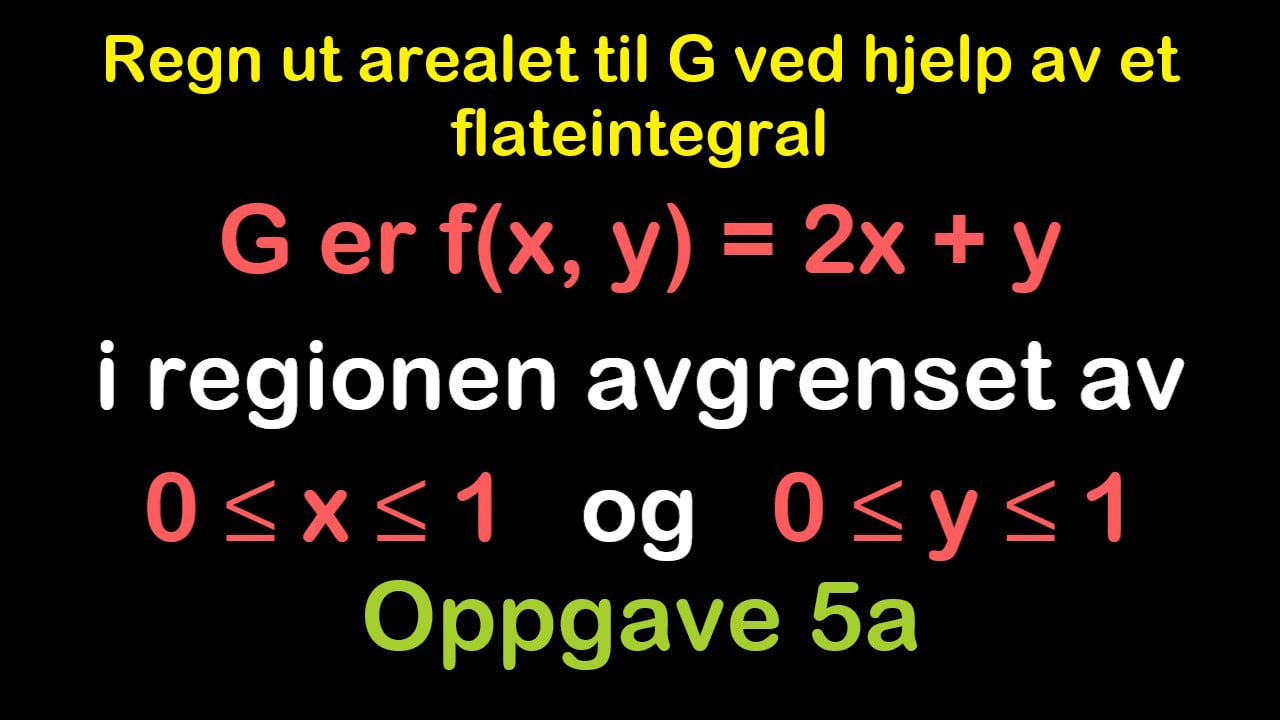 Video på matte.no: Regn ut arealet av G ved å beregne et flateintegral - 5a, video, 07:10
\( G \) lies above the square \( R \) in the \( {xy\text{-plane}}\text{.} \) We turn the surface integral into a double integral over \( R \) with the formula for surface area.
1. Draw a sketch
We draw a sketch first. \( G \) is part of the plane \( {z = 2x + y}\text{,} \) straight above the square \( R\text{:} \)
2. Write down the formula 0:17
When the surface is given by \( {F(x, y, z) = 0} \) and lies above \( R\text{,} \) the area is:
\[ A = \iint_R \dfrac{|\nabla F|}{|\nabla F \cdot \hat{k}|}\,dA \]If you are unsure about the formula, you can watch the video Overflateareal med flateintegral.
We move \( z \) over in \( {z = 2x + y}\text{,} \) and get:
\[ F(x, y, z) = 2x + y - z = 0 \]
3. Compute the fraction 1:35
The gradient is the vector of the partial derivatives of \( F\text{:} \)
\[ \begin{aligned} \nabla F &= \left(\dfrac{\partial F}{\partial x},\ \dfrac{\partial F}{\partial y},\ \dfrac{\partial F}{\partial z}\right) \\ &= (\textcolor{blue}{2},\ \textcolor{red}{1},\ \textcolor{green}{-1}) \end{aligned} \]
The length of a vector is:
\[ |(a, b, c)| = \sqrt{a^2 + b^2 + c^2} \]If you are unsure about this, you can watch the video Lengden til en Vektor.
That gives us:
\[ |\nabla F| = \sqrt{\textcolor{blue}{2}^2 + \textcolor{red}{1}^2 + (\textcolor{green}{-1})^2} = \sqrt{6} \]
The dot product with \( {\hat{k} = (0, 0, 1)} \) is a number, and we take its absolute value:
\[ \begin{aligned} \nabla F \cdot \hat{k} &= \textcolor{blue}{2} \cdot 0 + \textcolor{red}{1} \cdot 0 + (\textcolor{green}{-1}) \cdot 1 \\ &= -1 \\ |\nabla F \cdot \hat{k}| &= |-1| = 1 \end{aligned} \]
4. Compute the double integral 5:01
Plugging this in, we get:
\[ \begin{aligned} A &= \int_0^1\!\!\int_0^1 \dfrac{\sqrt{6}}{1}\,dx\,dy \\ &= \sqrt{6}\int_0^1\!\!\int_0^1 dx\,dy \end{aligned} \]
The integral \( \int_0^1\!\int_0^1 dx\,dy \) is the area of the square, which is \( 1\text{:} \)
\[ A = \sqrt{6} \cdot 1 = \sqrt{6} \]
Exercise 5b)
Consider the function Compute the surface integral
Show solutionHide solution for exercise 5b
Answer
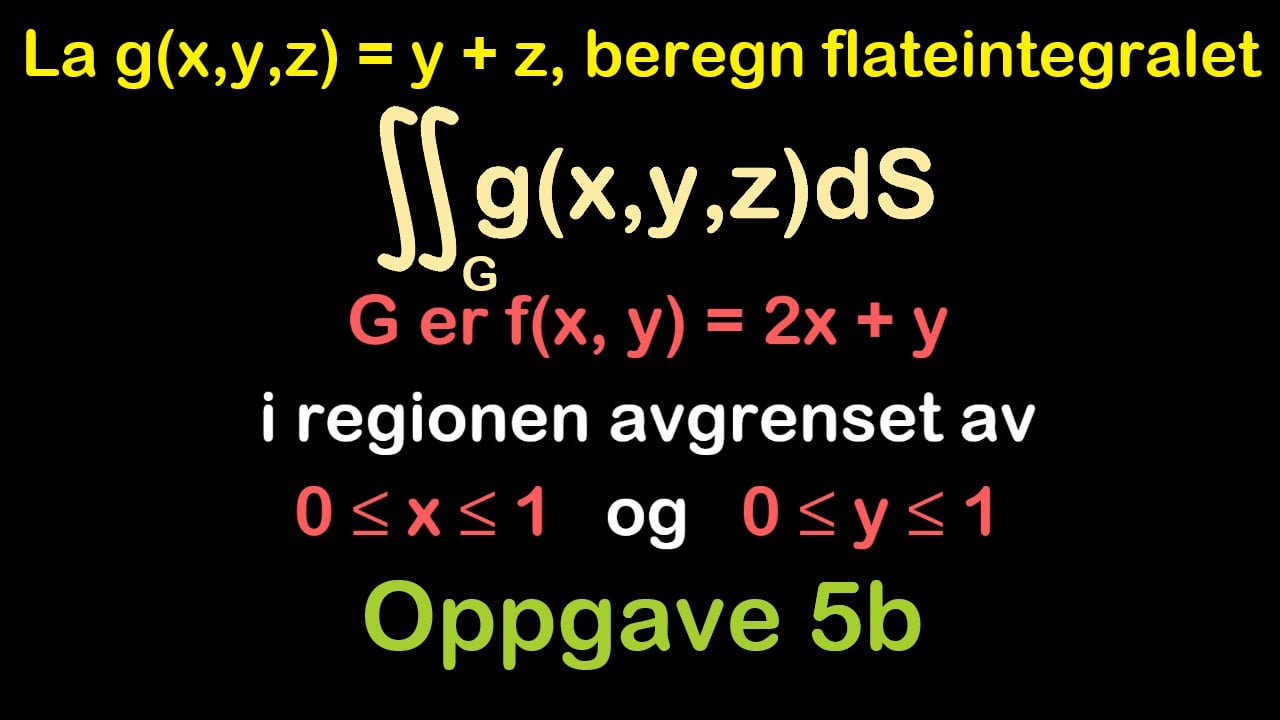 Video på matte.no: Betrakt 4D funksjonen og regn ut flateintegralet - 5b, video, 09:37
We use the fraction from a).
As in a), we turn the surface integral into a double integral over the square \( R\text{.} \) On \( G \) we have \( {z = 2x + y}\text{,} \) so we put that into \( g\text{.} \)
1. Rewrite the surface element 3:35
Over \( R \) the surface element is:
\[ dS = \dfrac{|\nabla F|}{|\nabla F \cdot \hat{k}|}\,dA \]This is the fraction from the formula for surface area in the video Overflateareal med flateintegral.
In a) we found that the fraction is \( \textcolor{darkorange}{\sqrt{6}}\text{,} \) with \( {F(x, y, z) = 2x + y - z}\text{.} \) That gives us:
\[ dS = \textcolor{darkorange}{\sqrt{6}}\,dA \]
2. Put in z 5:00
On \( G \) we have \( {\textcolor{blue}{z = 2x + y}}\text{,} \) so:
\[ \begin{aligned} g(x, y, \textcolor{blue}{2x + y}) &= y + \textcolor{blue}{2x + y} \\ &= 2x + 2y \end{aligned} \]
Plugging this in, we get:
\[ \begin{aligned} &\iint_G g\,dS \\ &= \int_0^1\!\!\int_0^1 (2x + 2y)\,\textcolor{darkorange}{\sqrt{6}}\,dx\,dy \\ &= \textcolor{darkorange}{\sqrt{6}}\int_0^1\!\!\int_0^1 (2x + 2y)\,dx\,dy \end{aligned} \]
3. Compute the inner integral 6:53
The power rule tells us that:
\[ \int x^n\,dx = \dfrac{x^{n+1}}{n+1} + C, \quad n \neq -1 \]If you are unsure about the rule, you can watch the video Basic integrasjonsregler/formler.
We integrate with respect to \( x \) first, term by term. Here \( y \) is a constant:
\[ \begin{aligned} \int_0^1 (2x + 2y)\,dx &= \Big[x^2 + 2xy\Big]_0^1 \\ &= 1 + 2y \end{aligned} \]
4. Compute the outer integral 8:14
Then with respect to \( y\text{:} \)
\[ \begin{aligned} \int_0^1 (1 + 2y)\,dy &= \Big[y + y^2\Big]_0^1 \\ &= 2 \end{aligned} \]
That gives us:
\[ \iint_G g\,dS = \textcolor{darkorange}{\sqrt{6}} \cdot 2 = 2\sqrt{6} \]
Ferdig med settet? Se de andre settene i Matte 3000, eller repeter temaene på fagsiden.